
AI is phenomenal, but without a strategy and sound processes, it achieves nothing

Artificial intelligence is a phenomenal digital technology. The possibilities are vast: faster analysis, smarter automation, new ways of working and new forms of service provision.

However, recent studies by Gartner and Apollo once again demonstrate what we at TIMAF have been seeing in practice for years: the technology itself is not the problem, and certainly not the solution. AI can only truly make a difference once organisations have first mapped out their strategy and processes.
The figures show that AI can bring value
Gartner: only 13 per cent are deriving significant value from AI
The Gartner 2027 CIO and Technology Executive Agenda survey of over 2,000 CIOs and technology executives worldwide reveals that only 13 per cent of CIOs say their organisation has realised significant or transformational value from AI. Whilst the number of AI use cases has increased fourfold in two years, the average probability of a use case succeeding remains one in five.
Gartner analyst Alicia Mullery puts it succinctly: “Volume is not value. AI is creating a reckoning for organisations that lack fundamental disciplines, such as defining use-case value in advance and establishing criteria for when to walk away.” Put simply: those who do not determine in advance what delivers value and when to stop will merely accumulate AI activity — not AI results.
The organisations that do achieve success – the ‘Vanguards’, accounting for just 11 per cent of organisations – do not invest more in AI than others. What does set them apart, however, is their discipline and the choices they make:
Organisations with clear criteria for when an AI pilot should not proceed to production are 2.3 times more likely to succeed.
Organisations with rules to stop low-value AI initiatives from going into production are even 2.6 times more likely to succeed.
Only 31 per cent and 17 per cent of CIOs have actually implemented these practices.

In short: the difference lies not in the technology, but in decisiveness, governance and pre-defined value – in other words: strategy and process.
The gap (‘disconnect’) between AI ambition and business results
The Gartner 2027 CIO Agenda identifies four fundamental ‘disconnects’ between AI ambition and business results:
AI ambition vs. budget reality — investment in agentic AI is growing by 31.8 per cent, whilst IT budgets are increasing by an average of just 3.7 per cent.
Decentralised adoption vs. centralised responsibility — 73 per cent of leaders expect more business-driven technology development, but 80 per cent have not properly assigned ownership of the costs for this technology.
Cost-saving expectations versus rising costs — 58 per cent of CIOs are under pressure to cut costs using AI, whilst 51 per cent expect AI to actually increase the total cost of ownership.
Efficiency expectations vs. growing talent needs — organisations expect productivity gains, but demand for data, analytics and security talent continues to grow.
None of these gaps is a technological problem. They are issues relating to strategic choices, funding models, responsibilities and process design.

Apollo: still no financial return outside the technology sector
The analysis by Apollo Chief Economist Torsten Slok in his article No Signs of AI Payoff Outside the Tech Sector extends to the macroeconomy. Despite massive investment and unrelenting hype, AI is yielding zero financial return outside the technology sector:
Revenue per employee is rising among the ‘Mag 7’ tech giants, but remains flat among the S&P 493 — the vast majority of the business sector.
Profit margins are rising among the tech giants, but remain flat among all other companies.
There is still no visible effect of AI on productivity growth.
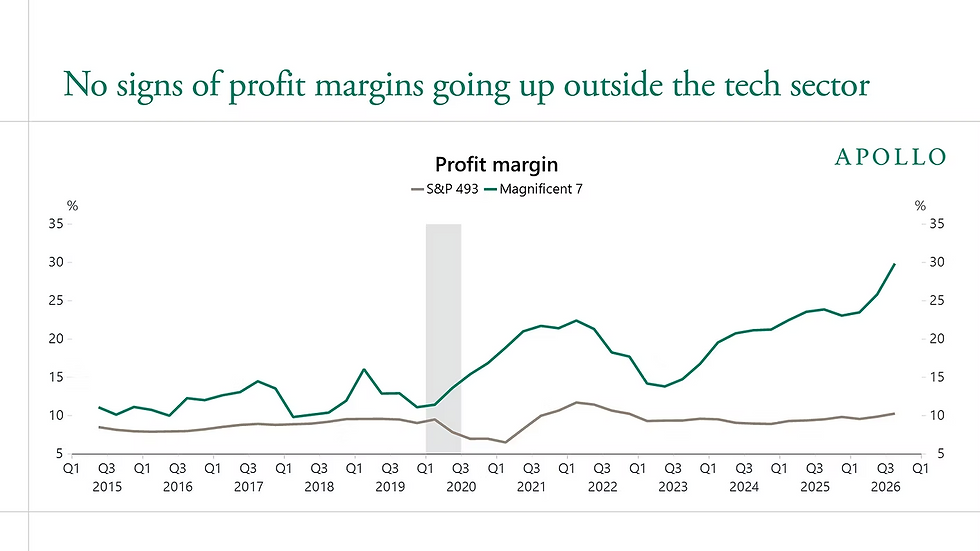
Slok highlights a crucial insight: AI may be a brilliant calculator, but in the business world, intelligence is primarily about judgement. And judgement depends on context, responsibility, trust, culture, unwritten rules and ethical considerations — precisely the things that AI has no grasp of.
Because many companies do not see that value in AI, they are increasingly viewing AI-related expenditure as a cost rather than a driver of growth.

The crux of the matter: AI enhances what already exists
What both studies underline is precisely the message that TIMAF has been promoting for years:
Technology is of no use without an optimal strategy and an optimal process.
AI acts as an amplifier. For those who have not mapped out their processes, AI primarily amplifies the red tape, the costs and the chaos. Those who do have a clear digital strategy, who assess the value of digital initiatives in advance, who apply cut-off criteria and who redesign processes around collaboration between humans and AI, belong to the small group that actually achieves results.
The Gartner figures prove it: the ‘vanguards’ distinguish themselves not through more technology, but through better decisions, governance and process discipline. This message is not new, but in the midst of the AI hype, it is more relevant than ever.
What does this mean for your organisation?
Before you invest (even more) in AI tools:
Map out the strategy. What is the digital ambition, what value do you want to realise, and which use cases contribute to this? Define in advance what success means — and when to stop.
Map out the processes. AI is changing the way work is done. Anyone who does not explicitly design processes around human-AI collaboration is squandering the potential.
Establish governance and accountability. Ownership of costs, data and decisions must lie with the business, not implicitly with IT.
Redesign roles, not just tools. Only 4 per cent of organisations have concrete plans to redesign roles for a ‘human-agent’ organisation. Organisations that do redesign roles are 2.4 times more likely to be among the successful ones.
Learn to master both the process and the strategy: the TIMAF training courses
Strategy and process management are not optional. They are essential for deriving any benefit from AI. In our practical training courses, you will learn:
Process management: mapping, analysing, redesigning and improving processes — the foundation that every AI initiative needs to deliver value.
Digital strategy: developing a clear, value-driven strategy against which you can assess, prioritise and, where necessary, discontinue technology investments.
Both training courses are practical, directly applicable to your own organisation, and are delivered by trainers with many years’ experience in the field.
Sign up today. Don’t wait until your organisation turns out to be among the 87 per cent that are missing out on the significant value AI has to offer. Lay the foundations first: strategy and process. Only then can AI make a difference.
Sources used:
Gartner press release, 19 October 2026
Gartner 2027 CIO Agenda infographic
Apollo, "No Signs of AI Payoff Outside the Tech Sector", 24 October 2026


Comments