
AI as a catalyst: why digital maturity is no longer a choice

Artificial intelligence (AI) is no longer a vision of the future, but a reality that is sweeping through organisations. Organisations are turning to AI en masse as the ultimate solution for efficiency, innovation and competitive advantage. But the harsh reality is that many of these AI projects fail.

Why? Because AI is not a magic wand. It is a mirror: it amplifies what is already there. Poor processes get worse, unclear strategies lead to chaotic implementations, and poor collaboration results in isolated, unusable systems.
Work on digital maturity
At TIMAF, we see it every day: organisations that want to deploy AI come up against the limits of their own digital immaturity. AI exposes the weaknesses that have been lurking beneath the surface for years. And now, now that turning to AI seems to be the only way for many to keep up, it is becoming painfully clear: digital maturity is not a luxury, but a necessity.
Digital maturity indicates how an organisation deals with the organisational, IT, technological and cultural challenges of a digital transformation.
The higher the level of digital maturity, the better an organisation is equipped to succeed in the digital age in which we now live.
Assessing digital maturity provides an organisation with a framework for determining which next steps need to be taken to reach a higher level and thereby achieve the organisation’s digital transformation.
The call to action: join forces
AI requires more than just technological progress. It demands a fundamental shift in how organisations think and work. And that can only succeed if professionals from all corners of the organisation join forces. Information managers, process experts, architects, IT specialists, lawyers, procurement officers – everyone must be at the table. Because digital maturity is not a task for a single department. It is a shared responsibility.
All too often, we see disciplines operating in silos. IT builds systems without taking into account the business processes that need to run on them. Legal departments draw up frameworks without understanding the technological possibilities. Procurement selects tools that do not fit with the architecture. The result? Fragmentation, inefficiency and missed opportunities.
AI is forcing us to break down these barriers
See AI as an opportunity to really put your own profession or discipline on the map. Stop shouting from within your own discipline. This comes across as “there he goes again with his usual pet subjects” and doesn’t make any difference. Come to think of it, various professionals have been saying since the 1990s that we need to improve the quality of our data and web channels, that we need to listen better, develop a strategy, draw up a proper policy with clear guidelines, and so on. And all of this is true, but over the years it has led to little or nothing.
So things need to be different now. The AI hype is the ultimate test of collaboration. Only by joining forces – by linking strategy, governance, processes, data, architecture and culture – can we harness the full potential of AI. And that starts with recognising that digital maturity is a collective endeavour.
The dimensions: why collaboration makes all the difference
TIMAF has developed a practical maturity model comprising various dimensions against which you can assess both your digital ambitions and your current situation.
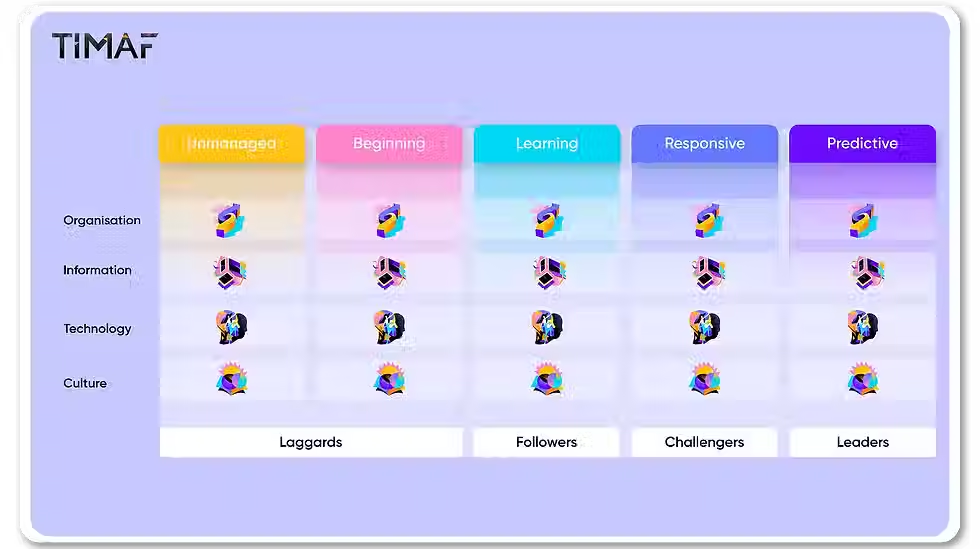
These dimensions of digital maturity are not separate pieces of a jigsaw puzzle. They are inextricably linked. And it is precisely at the intersection of these dimensions that the magic happens. As an example, I will take six dimensions from the maturity model:
Strategy and governance must go hand in hand. A clear AI vision is of no value without clear responsibilities and ethical frameworks.
Processes and data quality are inseparable. Standardised, automated processes ensure reliable data – the fuel for AI.
Architecture and collaboration determine whether AI solutions can actually be integrated and scaled. A modular IT environment is worthless if departments do not communicate with one another.
Each dimension requires expertise from different disciplines. And that is precisely why collaboration is key. Only by combining the knowledge and experience of information managers, process experts, architects, IT professionals, lawyers and procurement specialists can we tackle the complexity of AI.
How do you go about it?
Digital maturity is not a final destination, but an ongoing process. Start with a digital maturity scan to see where your organisation stands. But – and this is crucial – involve representatives from all relevant disciplines from day one. Create multidisciplinary teams that work together to drive improvements across all six dimensions.
At TIMAF, we help organisations with our digital maturity model and practical tools such as workshops and simulations. But real change comes from within: from professionals who join forces and take responsibility for making their organisation AI-proof.
Take the self-assessment
Take the self-assessment to get an idea of the TIMAF maturity model. You can use the initial results to discuss with your colleagues.

We can help with digital maturity
Would you like to know how digitally mature your organisation is? And how you can strengthen collaboration across disciplines? Get in touch via info@timaf.nl and find out how we can help you.

We’d be happy to help you analyse your organisation’s digital maturity.
Download the ‘Digital Maturity in 2 Minutes’ infographic to get an idea of our approach.


Comments