
The challenge of any strategy: effective implementation

Many strategies fall by the wayside somewhere along the line: they are either not implemented at all or are poorly implemented. As a result, organisations lose their much-needed clout in these turbulent times.

In many organisations, strategic planning appears to be a top priority, but implementation turns out to be a lost art. Research shows that the critically deficient component is rarely the strategy itself, but rather the ability to put it into practice effectively.
Poor execution undermines strategic potential
In Turning Great Strategy into Great Performance, Michael Mankins and Richard Steele argue that companies see only 63% of their promises realised in financial performance on average. Organisations therefore lose almost a third of their strategic potential: a striking lack of execution power and targeted follow-up.
They advocate seven easy-to-apply rules to bridge this gap:
Keep it simple and concrete – avoid vagueness. Clearly state what the organisation will and will not do.
Discuss assumptions, not predictions – this will help you be less guided by uncertainties.
Work with cross-functional teams – bring together insights from strategy, marketing, and finance to test assumptions in a realistic context.
Use a solid analytical framework, for example by linking the long-term financial goal to interim indicators and objectives.
Discuss resource allocation early in the process—what to invest in and when is crucial for feasibility.
Clarify priorities—employees need to know where to focus their energy.
Continuous monitoring and adjustment – continuously measuring efforts and results against the plan, reevaluating your assumptions, and reallocating resources where necessary.
Rewarding and developing execution skills – monitoring performance and encouraging people to execute.
These rules show that implementation does not have to be any less complex than the strategy itself, but that a rigorous approach will bring you considerably closer to the promised result.
Don't reorganise, but give mandate and inform
In The Secrets to Successful Strategy Execution, Gary Neilson, Karla Martin, and Elizabeth Powers observe that when strategic execution falters, organisations too often resort to reorganisations and the distribution of rewards. However, these solutions are ineffective because they overlook two powerful and fundamental drivers of effective execution: mandate and information flow.
Survey data from more than 125,000 employees in approximately 1,000 organisations in more than 50 countries shows that:
Clarity about who makes and implements which decisions is crucial. Employees who know what is expected of them do not need to be radically reassessed.
Fast and accurate information flows, both vertically (up-down) and horizontally, ensure that relevant competitive information and success factors move across the lines in a timely manner.
Once these fundamentals (decision-making, information) are in place, incentives—such as performance reviews and bonuses—will naturally fall into place. That is why rewards should only be used after these basic steps have been taken.
Interestingly, structural changes appear to be more effective when they are implemented laterally and at a slower pace. For example, by placing employees in new roles within teams, rather than implementing major reorganisations from above.
In short: effective implementation does not start with structure or incentives, but with clarity and transparency in decisions and communication.
Make strategic implementation successful
The TIMAF book Strategy in Digital Transformation explains how to successfully implement a strategy, ensuring that the right information reaches the right people at the right time, who also have the right mandate to make quick decisions. This is crucial for a successful digital transformation.
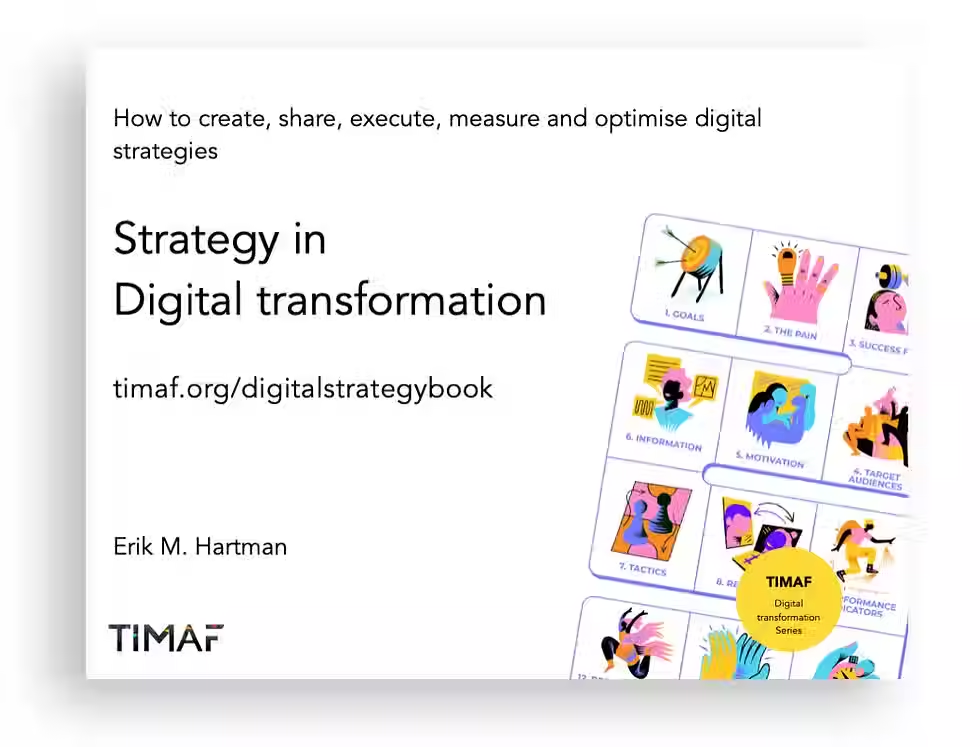
The book Strategy in Digital Transformation is a practical guide and reference work that teaches you how to create a digital strategy that is feasible in practice.
The e-book will be released this September in ePUB and PDF formats. The paperback version will be released in October.
The English version will be released first, followed shortly by the Dutch version at the end of this year.
Free e-book for subscribers
Subscribers to the TIMAF newsletter receive the e-book free of charge.


Comments