
Digital maturity: the essential foundation for digital transformation

Without digital maturity, no AI implementation within an organisation will be successful. That is the harsh reality that many organisations are facing. It is therefore essential to improve digital maturity today.

Digital maturity measures how an organisation deals with the organisational, informational, technological and cultural challenges of digital transformation. The higher the level of maturity, the better equipped an organisation is to succeed in the digital age.
Why digital maturity needs to be measurable
Assessing digital maturity provides an organisation with a clear point of reference. It helps to determine which steps are needed to reach a higher level and thus actually achieve digital transformation. Without this assessment, the chances of success are slim.
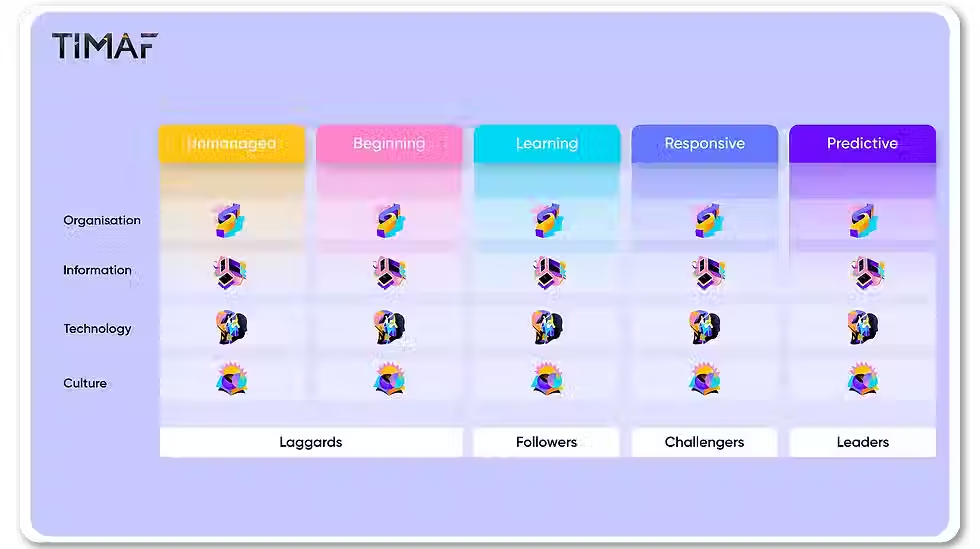
This is also evident from the new TIMAF AI / Digital maturity benchmark where organisations can assess their AI initiatives and compare them with others. AI amplifies what already exists: poor processes become worse, unclear strategies lead to chaos, and inadequate collaboration results in isolated systems that add no value.
The pitfalls of an overly ambitious approach
Many organisations are struggling with the transformation into a digital, future-proof organisation. They are often too ambitious: they think that purchasing new technology or jumping on the latest bandwagon will bring about the change. But nothing could be further from the truth.
Digital transformation fails if the organisation is struggling with:
Flawed strategy implementation or unclear governance;
Inefficient processes and immature business operations;
Poor quality of information (both data and content), which undermines any data-driven attempt at transformation;
A lack of architecture: without a robust and flexible foundation, ambitions will stall;
Insufficient digital skills amongst staff. If they are already struggling with the current tools, introducing new technologies will not increase digital maturity – in fact, it will exacerbate the problems;
A culture that is not ready for change. This is perhaps the greatest challenge of all.
The role of leadership
Senior management tends to ignore current problems and allow itself to be swayed by the success stories of other organisations. They want digital transformation – and they want it now. Substantial budgets and reorganisation follow, but without the right foundations, failure is inevitable.
Instead, management should focus on improving digital maturity. Only when the organisation is ready and equipped can it learn from successes and failures on the path to a successful digital transformation.
Practical steps towards adulthood
Work on your organisation’s digital maturity first, before you consider a digital transformation. Take the time to:
To assess the current level of digital maturity (for example, using the self-assessment);
To share the results and define the desired level of maturity;
To draw up an action plan;
To work towards improvement step by step, focusing on all dimensions: such as strategy, processes, technology, information, architecture and culture.
We can help with digital maturity
Would you like to know how digitally mature your organisation is? And how you can strengthen collaboration between disciplines? Get in touch at info@timaf.org and find out how we can help you.

We’d be happy to help you analyse your organisation’s digital maturity.
Download the ‘Digital Maturity in 2 Minutes’ infographic to get an idea of our approach.
Take part in the benchmark and find out where you stand!
Are you curious to find out how digitally mature your organisation is? And how you can strengthen collaboration between disciplines? Then take part in the AI / Digital Maturity Benchmark now at https://www.timaf.org/selftest-digital-maturity

Want to find out more?

You can find out more about digital maturity and digital strategy in the book *Strategy in Digital Transformation* by TIMAF adviser Erik Hartman,
This ‘how-to’ guide teaches you how to strengthen your organisation’s digital maturity through a digital strategy.


Comments