
Strategy is the steering wheel, not the brake

Perhaps this scenario sounds familiar: the organisation is at the start of a digital replacement. It is investing in a new CMS, a new website with portals, a CRM system for all internal processes, and the integration of all these elements. Time is of the essence, as the systems are urgently needed. The old systems are no longer adequate, and there is therefore considerable pressure to replace the digital technology quickly.

And then, at some point during discussions about the ‘why’ and the strategy, someone says: ‘We don’t have time for strategy right now. Implementation first, strategy later.’ That sounds efficient, until you realise what has actually been decided. Let’s take a look at the consequences when an organisation rushes to implement digital systems and puts off the strategy ‘until later’.
What you actually decide: technology controls you
“No strategy for now” does not mean that no strategic decisions are being made. It simply means that they are not being made by you, but by the person building the systems. What data does the CRM record? Which processes are incorporated into it? What is made available via the customer portals? How is the website structured?
These aren’t technical questions — they’re strategic questions dressed up as technical ones. If you leave them to the implementation team and the supplier, the technology will drive the organisation — rather than the other way round. Anyone wishing to make adjustments later on will find that reconfiguration, data migration and the partial rebuilding of the portals become a very costly undertaking. But the budget had already been spent during the earlier implementation, so the changes are then either carried out half-heartedly or not at all.
Digital technology must solve a problem
In my book Strategy in Digital Transformation, I describe strategy as an end-to-end process. The value of a strategy lies in solving the problem. Digital technology must demonstrably help to solve that problem.
If the problem and the process for solving it are not clear, there is a high chance that the system will make little or no contribution to solving the problem. A system that does not solve a problem is a solution in search of a problem. In other words, ‘problems’ are sought – and perhaps even found – that are not organisational problems at all.
The most underestimated loss: leadership
Without a strategy, there are no success factors. Without success factors, there are no KPIs (key performance indicators). Without KPIs, there are no dashboards that truly inform decision-makers. And that leaves just one thing: a system whose only measurable success is ‘delivered on time and within budget’.
No one would deliberately set up a system like that. But it arises naturally as soon as the final link in the chain is missing: the connection between what the organisation wants to achieve and what the systems are supposed to do. The board and management then see only milestones, not the actual impact. Course correction only comes after delivery — at the very moment when making corrections is most costly. Not just in a technical sense, but also organisationally, because people were still unable to work effectively on solving the problem.
Dashboards are therefore not a luxury finishing touch that only comes into play once everything is complete. They are the tool that enables the organisational strategy to learn and make adjustments during implementation. And you can only build them once you have first identified the success factors — these do not come from a technical plan, but from the translated strategy.
An example: the commercial organisation
Take a commercial organisation with a clear ambition: to attract new customers, improve customer retention and strengthen brand preference. The strategy sets out objectives such as ‘reaching more customers’ and ‘making a difference to more customers’. The management team is seeing customer numbers fall and wants to reverse this trend. These are the core ambitions, not side issues.
So what does a digital strategy deliver right now, before the system goes ‘live’?
A CRM system designed with customer retention and customer value in mind, not for administrative purposes. Customer profiles, purchase and contact history, engagement, and churn risks — at the heart of the data structure, so that the system alerts you before a customer leaves. You can’t just ‘sort that out later’.
A website and customer portals built around the customer journey and the customer’s concerns — not around the organisation’s departmental structure. A content strategy that already determines how information and offerings are made accessible, labelled and personalised.
A CMS-CRM integration capable of answering the key question: which signals predict customer churn, and which predict growth? The technology is only valuable if that question is asked in advance.
Measurement from day one: customer retention by segment, revenue growth from campaigns, reach and conversion rates amongst the target audience — visible to the board, management and frontline staff.
If you do this after implementation, all the building blocks will already have been defined based on the assumptions made by the supplier and the project team. If the choice was a poor one, this will be followed by data migration, rebuilding and redesign — twice what it would have cost if you’d handled this properly from the outset.
And then there are the silos
There is usually something else at play. Organisations are often divided: the board, management and the shop floor view one another from a distance. There is little shared frame of reference, little common language regarding what digitalisation means for the organisation’s mission.
Now, of all times, is the moment to break through this. The implementation of new systems is perhaps the only time when processes, data flows and collaboration can be structurally reorganised.
Joint strategy sessions – with the board, management and front-line staff all around the same table – achieve something no project document ever can: they foster ownership and establish a shared framework for assessment. If you let this opportunity slip by, the silos will not be broken down but set in stone. The CRM and customer portals will then cement the existing divisions for years to come.
Conversely, implementation feeds into the strategy. Data from the CRM, content performance and customer interactions are precisely the sources that enable the organisational strategy to determine whether it is working and what needs to be improved. Without this feedback loop, the strategy remains a static document and the systems remain costly infrastructure with no value for steering the organisation.
Strategy as a guiding principle
Strategy is not a brake on implementation. It is the steering wheel. Technology without a steering wheel still moves — just not necessarily in the direction the organisation wants to go.
In practice, ‘systems first, strategy second’ means: first set up an administration system and a website, and only then realise that the tool for what you really want to achieve hasn’t been built in. That’s not efficiency; it’s a detour with enormous costs of failure at the end.
So to everyone in this situation – in a hurry and reluctant to engage in “yet more consultation” – the proposal needn’t be a difficult one:
Translate the organisational objective into digital systems;
Identify the success factors, KPIs and dashboards for each decision-making level;
Define ownership and establish a small governance group in which all levels are represented;
Determine the frequency at which implementation feeds into the organisational strategy — and vice versa.
This is a rather ‘lightweight’ approach that can be carried out in parallel with implementation, without disrupting the schedule. It is also the most cost-effective safeguard for one of the largest investments an organisation makes. And it is the difference between systems that simply work — and systems that make a real difference.
More about digital strategy

Would you like to find out more about the ‘end-to-end’ strategy process and how to develop a digital strategy that helps solve organisational problems?
Then read my new book, Strategy in Digital Transformation. (Available as a PDF, ePUB and paperback).
Sign up for the strategy training course!
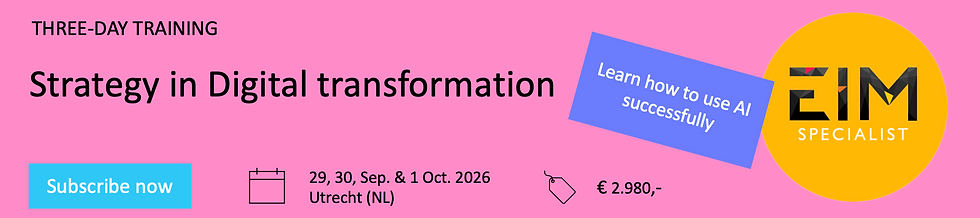
Would you like to learn how to use digital technology effectively and solve real-world problems? In the ‘Strategy in Digital Transformation’ training course, you’ll learn how to use digital technology to make a tangible difference within your organisation.
Sign up for our ‘Digital Strategy’ training course or contact us to arrange a bespoke workshop.


Comments